Artist Biography
by Stephen Howell
The idea behind
the Thrown Ups was to have a band where no one ever practiced and no one ever wrote songs. At their first show opening for
Hüsker Dü
in February of 1985, the group brought raw oysters to throw at the
audience if the reaction was negative. The response turned out to be
positive, but the band doused the crowd with the sea creatures anyway.
Such practice became commonplace for the group, which began to
incorporate visual elements in case the music was horrific. The most
famous of
the Thrown Ups' lineups included vocalist
Ed Fotheringham, guitarist
Steve Turner, drummer
Mark McLaughlin (aka
Mark Arm), and band founder/bassist
John Beezer (aka
Leighton Beezer).
Beezer
had met his fellow bandmates at one of his house parties in February of
1984. When they were on-stage, anything could happen. On one such
occasion, dubbed "the Bloody Pooper,"
Fotheringham
rigged a bottle of ketchup to a tube that expelled the condiment from
the back of his pants. The end result was a terrified audience covered
in the substance.
Seattle's
Thrown Ups began in the basement of the home occupied by
Beezer and original vocalist
Steve Mack
in 1984. Since the pair had a variety of instruments in the house, they
invited anyone who stopped by to sit in on a jam, whether or not the
people knew how to play. Friend
Mike Faulhaber happened to be hanging out there quite frequently and took up the guitar. Rounded out by a drum machine,
the Thrown Ups were born.
Mack left by the end of the year and moved to Europe, where he formed
That Petrol Emotion with two former members of punk rock band
the Undertones.
Fotheringham joined as the band's vocalist in the fall of 1984, followed by the group's mutual friend,
Scott Schickler, on drums. By October of 1985,
Faulhaber had also left
the Thrown Ups in order to move to England.
Beezer ran into guitarist
Steve Turner at the Brookes Brothers store in Seattle.
Beezer explained the idea behind his new band to
Turner and offered him the guitar spot vacated by
Faulhaber.
Turner tried to decline, but
Beezer persuaded him to join by explaining that
Turner would never have to write songs at practice, since the group was based around improvisation.
Schickler left
the Thrown Ups in 1986, which happened to be around the same time that
McLaughlin was leaving the Seattle group
Green River.
McLaughlin agreed to fill in as
the Thrown Ups' drummer.
By this time, the band was gigging at Seattle
venues, such as the Vogue and Scoundrel's Lair, opening up for bands
like
Bundle of Hiss. By mid-year,
Turner approached
Tom Hazelmeyer, founder of Amphetamine Reptile Records, about releasing some material from the band. At first,
Hazelmeyer displayed total disinterest, but after
Turner played a snippet of a
Thrown Ups practice tape,
Hazelmeyer agreed to distribute all of the band's material. Prior to this, Amphetamine Reptile was solely a vehicle to release music by
Hazelmeyer's own band,
Halo of Flies.
The Thrown Ups became the first group that was actually signed to the
label. The band booked time at Seattle's Reciprocal Recording and laid
down their Felch single with engineer
Jack Endino. By early 1987, the record caught the attention of various critics, which included future Matador Records co-owner
Gerard Cosloy.
Almost everyone who heard the release gave it critical praise. That
summer, the band returned to Reciprocal Recording, recorded the Smiling
Panties single, and released it late that year. This was followed by the
recording of the Eat My Dump 7" in February of 1988. An outtake from
that session, titled "You Lost It," appeared on that year's
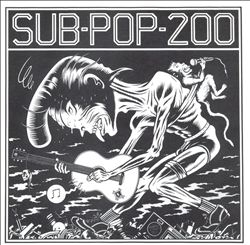
Sub Pop 200 compilation of Seattle groups.
By this time,
Turner and
McLaughlin had started the band
Mudhoney with
Melvins bassist
Matt Lukin and former
Bundle of Hiss drummer
Dan Peters. That Halloween,
Mack returned to Seattle with
That Petrol Emotion, who was receiving airplay on MTV. The band was playing a show at the Moore Theater, where
the Thrown Ups were opening. During
the Thrown Ups' set, they used
That Petrol Emotion's amplifiers. The Thrown Ups were playing at such an extreme volume that the roadies from
That Petrol Emotion feared
the Thrown Ups would blow the gear. Midway through
the Thrown Ups' set,
That Petrol Emotion's road crew appeared on-stage to turn the volume down. According to
Beezer, "Patrick McDonald, the classic big-paper rock critic, panned us as being loud, sloppy, garage-inspired crap."
Beezer
finished by stating, "[McDonald] was right -- apparently he hadn't
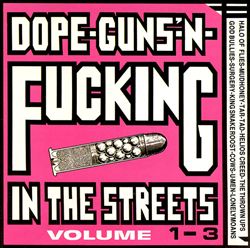
heard of grunge yet." By 1989, Amphetamine Reptile released their
Dope, Guns and Fucking in the Streets, Vols. 1-3 compilation, which included a track from
the Thrown Ups' Felch session. 1989 also found
the Thrown Ups back at Reciprocal with
Endino
recording their only full-length album, Melancholy Girlhole. It
appeared on the Munich, Germany, label Glitterhouse the following year,
while it was released in the United States by Amphetamine Reptile as
three 7" records.
In the next two years,
Turner and
McLaughlin began devoting their main attention to
Mudhoney. As a result,
Beezer kicked everyone out of
the Thrown Ups in 1991 and labeled its former members as sellouts.
Beezer
said this was a convenient excuse to avoid arguments, although the real
reason he broke up the band was due to the fact that it had exceeded
its lifespan. While
Turner and
McLaughlin were spending their post-
Thrown Ups' days in
Mudhoney,
Beezer
went on to form the bands El Grand Conquistador and Stomach Pump. He
also kept busy as a program manager and developer for Microsoft.
Fotheringham pursued his career in art, designing album covers for
Mudhoney,
as well as many jazz labels like Verve. The Thrown Ups' complete
discography for Amphetamine Reptile appeared on a single album, titled
Seven Years Golden, on January 28, 1997. The record also contained three bonus tracks. According to
Beezer, one of the previously unavailable songs, called "Bucking Retards," was a prototype for
Mudhoney's "Keep It Out of My Face."